Title
Primary topic + page value + brand, without stacking multiple near-duplicate variants.
A screenshot-backed implementation case study on anjumananwar.site showing how I moved from keyword discovery and search-intent decisions to URL mapping, titles, meta descriptions, H1s, internal links and crawl-depth validation.
The research was filtered by business fit, search intent, location relevance, demand and whether a phrase could be used naturally. Comparison terms were separated from direct service intent instead of being forced into money pages.
Examples from the Google Keyword Planner export reviewed during the project.
| Keyword | Avg. monthly searches | Decision |
|---|---|---|
| seo expert in bangladesh | 1,900 | Core provider intent |
| seo specialist in bangladesh | 110 | Supporting provider variant |
| seo consultant in bangladesh | 50 | Supporting commercial variant |
| on page seo | 390 | Service/topic support |
| technical seo | 260 | Service/topic support |
Data note: Google Keyword Planner export period shown in the working file was 1 Jul 2025–30 Jun 2026. Search volume was used as a signal, not as the only decision factor.
A keyword was mapped only when the page naturally matched what the searcher wanted. Similar words were allowed across the site when the page purpose was different.
No keyword stuffingMapping reduced overlap between provider, service, evidence, trust and informational pages. The goal was not to repeat the same keyword everywhere; it was to make the site architecture clearer for users and search engines.
| URL | Primary intent / topic | Search intent | Role in the journey |
|---|---|---|---|
/ | SEO Expert in Bangladesh | Commercial / provider | Primary personal-service entry point |
/seo-services/ | SEO Services in Bangladesh | Commercial / transactional | Service scope and conversion |
/meta-ads/ | Meta Ads Services in Bangladesh | Commercial / transactional | Paid social service page |
/about/ | Anjuman Anwar · SEO Specialist | Branded / authority | Trust, positioning and identity |
/case-studies/ | SEO & Meta Ads Case Studies | Commercial investigation | Proof and before/after evidence |
/seo-portfolio/ | SEO Portfolio & Analytics | Commercial investigation | Broader implementation evidence |
/reviews/ | Anjuman Anwar Client Reviews | Branded / trust | Client voice and reassurance |
/blog/ | SEO & Meta Ads Blog | Informational hub | Educational/topical support |
I aligned titles, descriptions, H1s and supporting copy with the mapped page purpose. Exact-match phrasing was used selectively; natural editorial language was retained where it improved trust and readability.
Primary topic + page value + brand, without stacking multiple near-duplicate variants.
Intent-aligned description with scope, value and a clear reason to click.
One clear main heading per reviewed page, balancing keywords with human-facing positioning.
Supporting terms were placed where they accurately described services, evidence or informational topics.
Title: SEO Services in Bangladesh | Technical SEO & Audits | Anjuman Anwar
H1: Evidence-led SEO services in Bangladesh for clear priorities.
Title: SEO Expert in Bangladesh & Meta Ads Marketer | Anjuman Anwar
H1: Meta Ads Marketer & SEO Specialist.
The primary phrase was carried in the title while the H1 stayed natural and brand-led rather than being forced into an exact-match template.
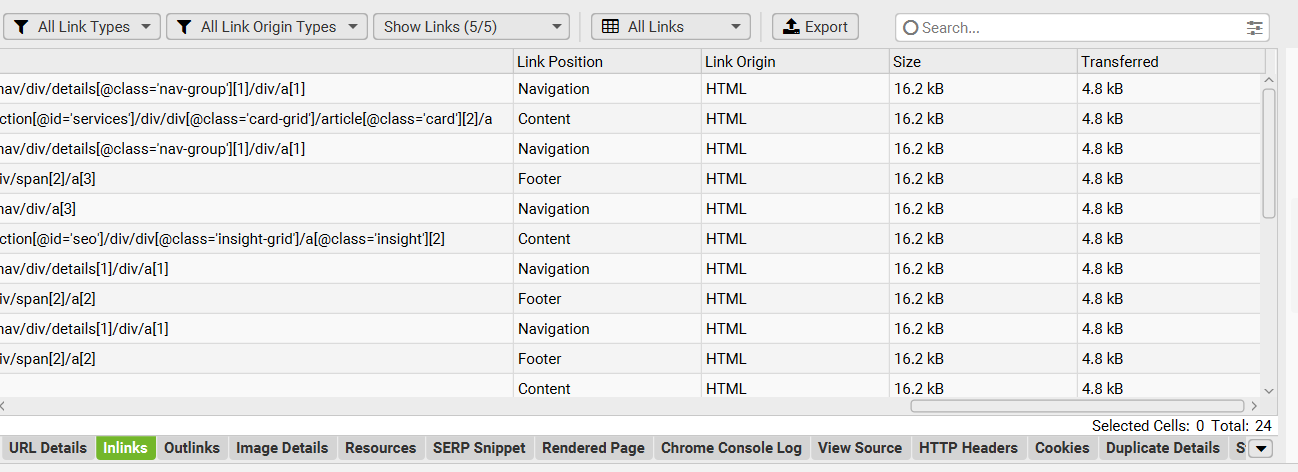
A fresh crawl was used to validate implementation across titles, meta descriptions, H1s, status/indexability, anchor text and crawl depth. The screenshots below are the working evidence from that QA pass.
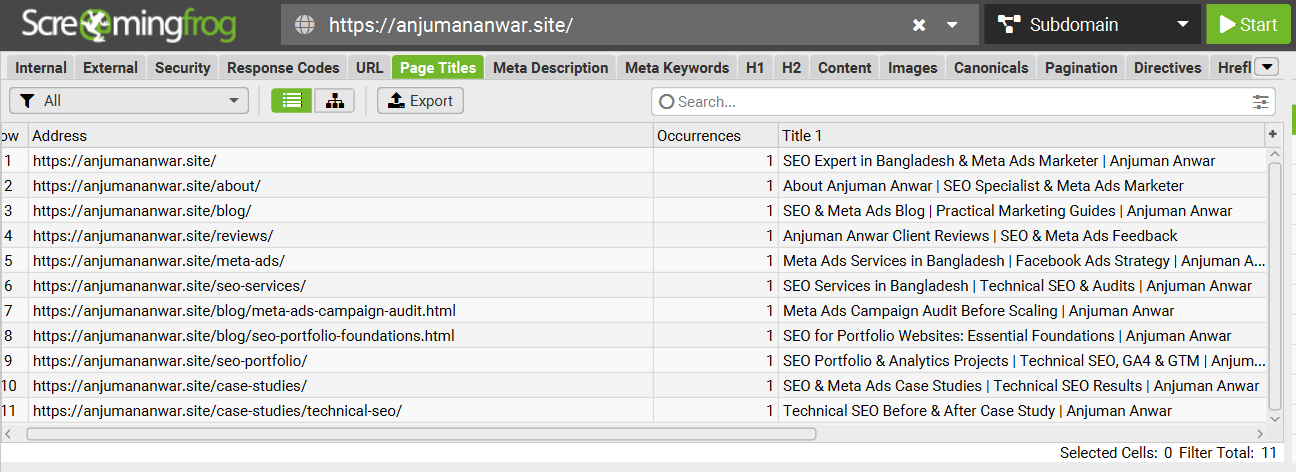
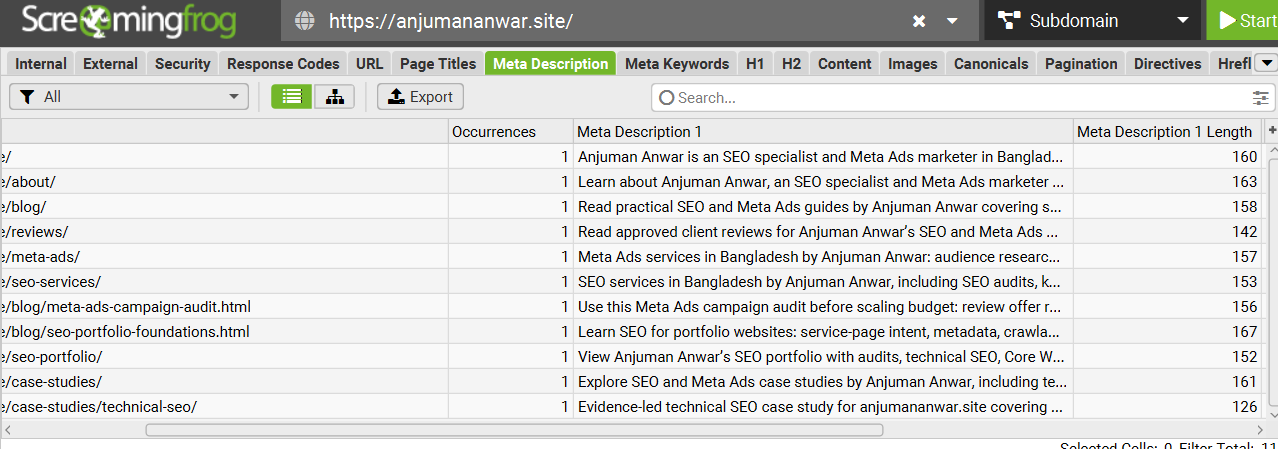
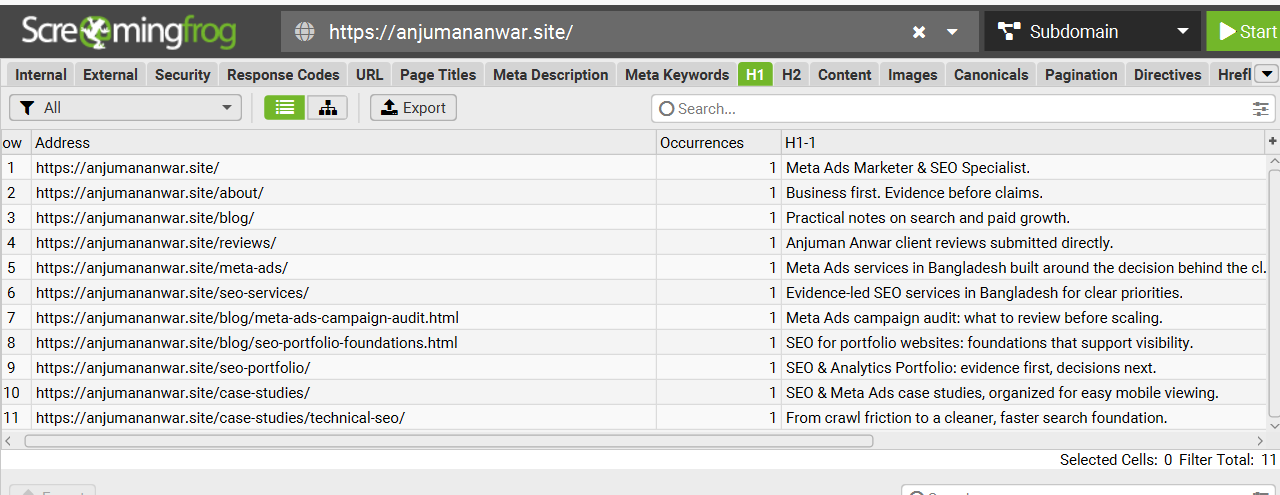
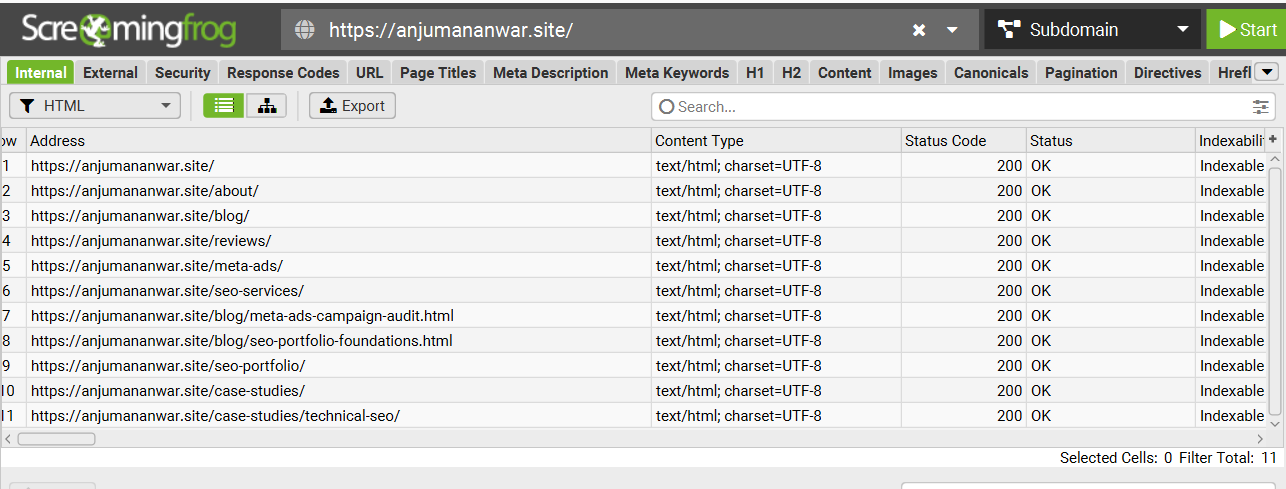
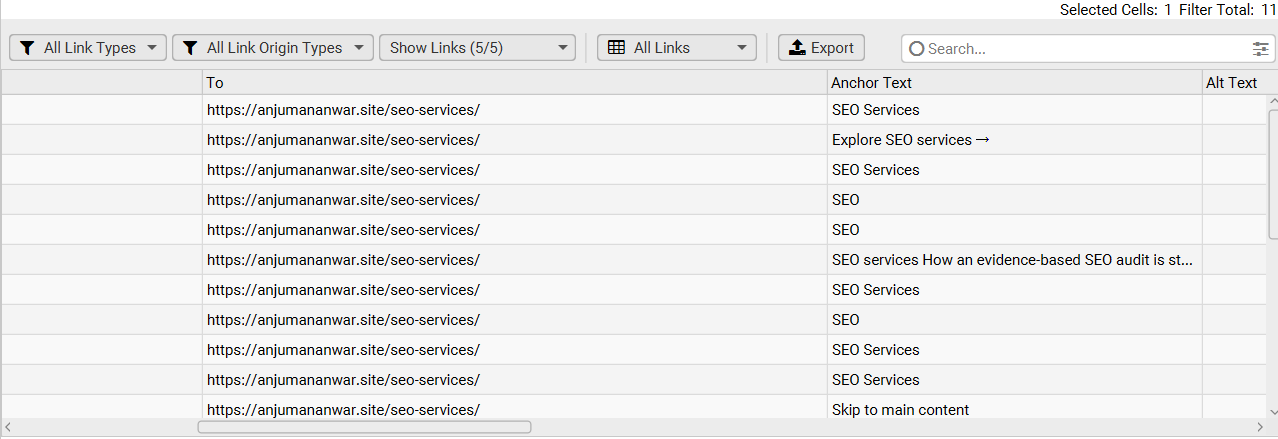
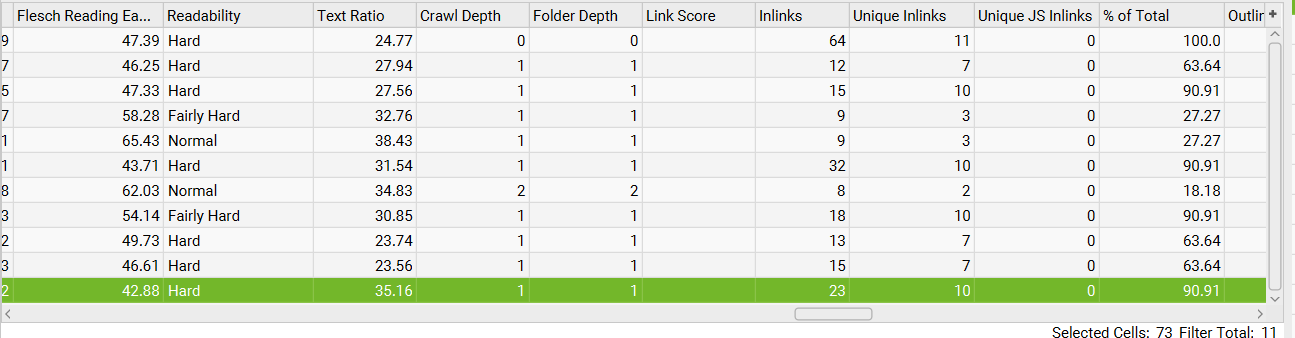
For the SEO Services page, the exported Screaming Frog inlinks report contained 24 internal links from 10 unique source pages. I separated sitewide/navigation links from contextual content links instead of treating every raw inlink as equal.
One “Content” row was the page’s own accessibility skip link, so it was not treated as a contextual SEO recommendation.
The value of the work was the sequence: research → intent → mapping → implementation → internal linking → crawl QA. This creates a repeatable workflow that can be applied to client sites without relying on keyword density or blind template optimization.